Saturday, September 10, 2005

Parcell Press


One area of DIY media that I intend to explore more fully in this blog are "zines" ... usually low-tech self published magazines of varying content.

Zines have been around as long as the printing press. In the modern sense, zines arose on a number of fronts during the 1950s and 60s when inexpensive reproduction methods became more widely available to everyday people: poetry / literary magazines became more widely published thanks to Beat Generation writers; civil rights and political zines sprung up during the 1960s; music zines pressed into the forefront as the VietNam War rolled toward US pullout and punk/radical politics zines were all the rage shortly thereafter. Concurrently, very personal zines evolved that focus on a writer's experiences & reflections sometimes enhanced with fiction or poetry mixed in.

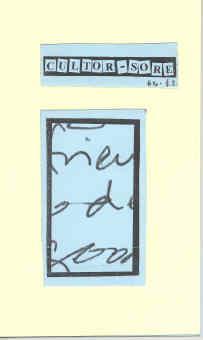
My favorite place to order zines is from Parcell Press at
www.parcellpress.com. Taylor is a writer/publisher of a fantastic zine called Cultor-Sore. Taylor also runs a zine distribution service. The website is easy to navigate, informative, and includes a decent variety of zines. I have found Taylor to be very personable and highly recommend both his zine and the distro service.

Review of Cultor Sore #16: Taylor draws the reader into Cultor-Sore #16 immediately with his engaging writing style. This issue is written entirely by Taylor and is filled with reflections, vignettes and stories from his life. He says in the introduction “Everything in this zine is real. When I step away from this paper I can really hear my neighbor yelling at his dog. I really can suck into my lungs the salty gusts of wind that drive up from home. I really do worry a lot, celebrate a lot, miss people I love, and think about them endlessly. I really am me, and I really am here.” Every page in Cultor-Sore crackles with energy because Taylor’s writing is evocative and descriptive. He also includes interesting zine and music reviews. Order this issue from Parcell Press and prepare to be immersed.

Please stay tuned for more postings on zines, shortwave radio, pirate radio, my humble radio projects, musical excursions, and other forms of enlightenment!

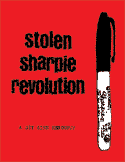
Stolen Sharpie Revolution


Stolen Sharpie Revolution is an essential guide to creating your own lost cost zines. This guide is simple to read, logically organized, and full of useful tips for DIY zine publishing. Information abounds on photocopying techniques, doing creative layouts, mail art, zine ettiquette, distributors, homemade paper, starting/working a distro, how to put out a record, how to make your own envelopes and stationary, binding ideas, cures for writers block and a list of resources. The price of this book is only $4!

Stolen Sharpie Revolution gets DJ Frederick's highest reccomendation. It is available from
www.parcellpress.com or www.microcosmpublishing.com

The zine revolution is literally in your hands. Creative expression is not a spectator sport!

Monday, August 29, 2005

1220 kHz


This is something I definitely want to turn readers and listeners onto: The Elemental Chrysalis is music by Chet W. Scott (RUHR HUNTER) & composer James Woodhead. The cd is housed in a 6" X 6" X 6" gatefold sleeve with wonderful woodland / psychedelic mushroom art. Musically The Elemental Chrysalis is unlike anything I've ever heard - and that is one of the highest compliments I could give a recording. The Glass Throat website states "Ponder one of Ennio Marricone's gloomy "spaghetti western" folkscapes, fused with a deeply unsettling Alexandro Jodorowsky film score! "The Calocybe Collection" is pregnant with "heavy" Elizabethan classical orchestrations & acoustic hallucinatory funeral drones! Imagine a Victorian Pink Floyd collaboration with a band of woodland gypsies, performing acoustic funeral doom!!! A beautifully intense experience, conjuring vast forests of fog quilted mushrooms & darkened paths of self discovery!!!". What more is there to be said?
This is music of powerful quietude and quiet power. Very earthy and very ethereal.

Instrumentation includes guitars, piano, cello, theremin, dilruba & more. Check out The Elemental Chrysalis & other excellent recordings at www.glassthroatrecordings.com

Monday, August 22, 2005

Robert Moog, 1934-2005


Robert Moog, the inventor whose synthesiser electrified the 1960s, dies of cancer aged 71

By David Usborne in New York

Robert Moog would not be expecting pipes or strings when friends and admirers from across the music world assemble in Asheville, North Carolina, tomorrow to bid him farewell. If there is to be Bach at his memorial service, please let it be switched-on Bach, created with currents of electricity.

Just four months after he was diagnosed with an inoperable brain tumour, Moog, the inventor of the series of music synthesisers that bore his name and helped to revolutionise modern rock sounds in the mid-Sixties and Seventies, died at his home in Asheville aged 71 on Sunday.

While other synthesisers may have been available, it was the Moogs to which bands and performers almost invariably turned. The Beatles used a Moog to record their last album, Abbey Road.


But more than anyone it was Walter Carlos - now Wendy following a sex change - who turned the Moog into a mainstream alternative to traditional instruments. His 1969 album Switched-On Bach, a collection of Bach pieces played with Moog machines, became the first classical album to go platinum. In 1977, we vibrated to the first completely Moog-synthesised pop hit, "I Feel Love" by Donna Summer.

Musicians chose the Moog because of the unique quality of sound it created. It soon began to serve as a solo instrument, particularly for artists such as Manfred Mann, Yes and Pink Floyd.

"The sound defined progressive music as we know it," said Keith Emerson, keyboards player with Emerson, Lake and Palmer.


It was back in 1954 that Moog first started his unusual career, building and selling so-called theremins with his father. Originally invented by a Russian of the same name in 1919, the theremin was a box that made strange musical sounds when the artist waved his hands between two protruding tubes. Ten years later, using new solid-state electronic technology and with the help of a New Jersey composer, Herbert Deutsch, he invented and marketed his first Moog Modular Synthesiser.

He can have had no idea at the time how far it would catapult popular music into its electronic future. According to friends, he never felt like a musician or a star himself. He was just a technician.

He sold his Moog-making company in 1974, just as the popularity of the new synthesisers was peaking and before they were somewhat overshadowed by new digital sound-making machines. But the Moog sound never died and was kept alive over the ensuing years by progressive rock musicians such as Brian Eno and Frank Zappa as well as the Cure, Fatboy Slim and Stereolab.

Last year a documentary film about the inventor, simply called Moog, was released with tributes to him from a range of artists including DJ Logic, Money Mark, Mix Master Mike, Jean Jacques Perrey and Rick Wakeman, formerly of Yes.


Meanwhile, in recent years the musician Charles Carlini has been promoting a festival in his honour in New York City called Moogfest.

"He's like an Einstein of music," Mr Carlini said, shortly before Moog's death. "He sees it like, there's a thought, an idea in the air, and it passes through him. A lot of people don't realise what this man brought to the masses. He changed the way we hear music."

After spending much of the Nineties as research professor of music at the University of North Carolina, Moog returned to running a full-time electronic instrument business, opening his latest company, Moog Music, just three years ago.

Four other inventions that changed the musical world:

PIANOFORTE
The piano was developed in 1709 by Bartolomeo Cristofori di Francesco. Unlike the harpsichord, where the strings are plucked, the piano is a percussion instrument, which uses hammers to create the sound.


SAXOPHONE
The saxophone was invented by Adolphe Sax, and first exhibited at the 1841 Brussels exhibition. Originally intended as an orchestral instrument, it has transformed jazz.


ELECTRIC GUITAR
When the solid-body electric guitar first became commercially viable in the Fifties, Gibson approached the guitarist Les Paul to help develop a more stylish version. The Les Paul Model, as it was originally called, has changed little since its debut in 1952.


DRUMULATOR
The first Drumulator appeared in 1983, followed by drum machines from Linn and Oberheim, which paved the way for bass-heavy electronic music such as drum 'n' bass and house.

Wednesday, August 17, 2005

Popol Vuh


Popol Vuh became a group at the end of the 1960's thanks to
the figure of keyboard player Florian Fricke, who was also interested in the cinema. They recorded mostly in the 1970's
but released LPs sporadically through the 1990's.

With their first record, Affenstunde, the group (in that period it was just a trio with Holger Trulzsch on the percussion and Frank Fiedler at the sinthetizer) was included among cosmic music of Tangerine Dream but they distinguished themselves by their remarkable spiritualism. That record was the first one made by a group of rock music using the big Moog (not the mini-Moog).

Their next work In Den Garten Pharaos signed a more radical division between their own music and the clichè of cosmic music. Title-track begins with an apocalyptical atmosphere, an emphatic organ and chorus overture such as King Crimson; but percussions, wich are less and less linear up to become a psychedelic effect of frenetic noises and the prolonging organistic "wall", made that endless swoon a supernatural experience. So doing Fricke blends epic chaos of A Saucerful Of Secrets (noisy percussions plus ghostly choir) with indian mantra ecstasy.

Having disowned "black" tribalism of teutonic rock, Vuh is a masterpiece of atmospheric and celestial spiritualism, it is quite similar to a grave and humble church music. It is a rustling noise, a no time electronic vocalism, a tabla whispering with paradisiac notes. This ceremonial goes slowly in a disquieting emptiness according to the millionary rhythm of universe. Fricke's music explores metaphysical dens towards the essence of things looking for the interior sounds of oriental guru.
The best exemple of this new expression has been given by the Hosianna Mantra mess. Fricke's liturgy gives up to the magniloquent electronic of Tangerine Dream and discovers a more intimal and closed tone where cosmic music is considered universal harmony instead of sketch of science fiction, a "fioretto francescano" instead of symphonic hurricane, just like catharsical human music. Fricke's acoustic mysticism approaches ancient and modern music obtaining right music to space catacombs.

Hosianna Mantra's miraculous balance between sacred and profane, liturgic and laic, future and past, is the first one in popular music history (nothing to compare with Electric Prunes). Fricke (piano) and his classical group (Conny Veit, guitar, Robert Eliscu, oboe, Fritz Sonnleiter, violin, Klaus Wiese, tamboura, and Djong Yun, soprano from Korea) create a dreaming and crystal atmosphere, weak and fading, perfumed and charming. This group can be considered a small ensemble of chamber music.

The emotional crackling of instruments and slow melodies contribute to the restoration of natural order, in the name of a revision which refuses violence as instrument of liberation and leads to a state of huge ecstasy. Ah! intensive opening notes of piano seem to communicate at a distance with cembalo and violin so to build up a complete repeated scheme with infinitive variations.


Kyrie is an oniric whispering and its struggle lirics plunge into a thin rain of tamboura, piano and oboe. Eponymus mantra is a nervous crescendo of heavenly chords fluctuating without cohesion and dominated by oboe's melodies. Oboe is the leading instrument of Abschied, with a sad melody well connected to Renaissance dance theme, executed in ralenti.

But Segnung and Nicht Noch Im Himmel go back to "freeform" accompainment because of soprano's humble chant, with more and more humble and lyric prayers (in particular the second one, the more celestial and oniric of the whole album), alternating sometimes the guitar. Melody is reduced to the essential, a phrase continually repeated, and rhythm is almost completely inexistent.

Hosianna Mantra overturns the link between rock music and its traditional ispirations, infact they can all found among Indian folk, Renaissance chant, Baroque suite, Gregorian liturgy. Hosianna Mantra is the masterpiece of religious rock too, infinitely more genial than raga rock of Santana and others.

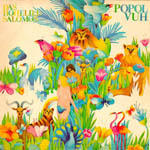
Accompanied by the devoted Daniel Fishelsher and by always different musicians, Fricke compose the mystic trilogy of Seligpreisung, Einsjager und Siebenjager and Das Hohelied Salomos, all extracted from sacred books. Having left the radical ascetism of the masterpiece, the music uses a compromise, but preserving its own simplicity.

Letzte Tage Letze Nachte, in trio again, finally changes direction, looking for a more easy and rhythmical sound, although lyric and maestoso. The monumentality and the arcane fascination of this suite link toghether to the requirements of cinema. Not by chance, Fricke becomes a devoted partner of director Werner Herzog, and composes many soundtracks for him ("Aguirre", "Kaspar Hauser", Coeur De Verre", "Nosferatu", "Fitzcarraldo", "Cobra Verde"). The best ones are Aguirre (in two parts) and Sohne Des Lichts (from "Nosferatu").

Later Fricke composed faint works, in particular Die Nacht Der Seele with Renate Knaup (ex Amon Duul) as singer. He comes back to Hosianna Mantra inspiration with the Tantric Songs, a collection of small chamber mantra and melodic sketches such as Harold Budd style (Listen He Who Ventures). The long Brothers Of Darkness has got a kind of unique brightness that is not evident in the first works, although its singing is sterile, according to a new tendency in the new age era.

Agape Agape suite (on the eponymous album) and Take The Tension High (on Spirit Of Peace) represent a period of transition ending with kinematical sound of City Raga, with Maya Rose as singer, Daniel Fischlscher at the guitar and Guido Hyeronymus at the keyboards.

Popol Vuh was an important band for having reacted to the cosmic
monumentalism of german rock works of mere lyric suggestion, recovering a way of making music within the rhythm of ancestral origin.


Friday, August 12, 2005

1130 kHz

It recently occured to me that I've never actually discussed in this blog exactly what kind of music I play on Seldom Heard Radio. I frequently post playlists to give readers a taste of the range you might hear during the broadcast. On the air I announce the show as "a freeform blend of esoteric music from the 1960's to the present". This isn't 100% true because I've played music from the 1930's, 40's and 50's (in small doses) as well over the years.

Because I love a variety of music it's easier for me to explain what you won't hear on Seldom Heard Radio. What you won't hear: rap, 95% of what has been called "country" music (since 1975 anyway), gospel music (though I have played less heavy handed Christian bands before) commercial pop ala Britney Spears, and klezmer music. Everything else is fair game.

I prefer "indie" music ... non-commercial music of all genres performed by people who have a passion for their craft. I also go wild for psychedelic folk music which has been called wyrd folk. During any given broadcast you could hear anything from R. Crumb and his Cheap Suit Serenaders to the Thievery Corporation all in the same set!

Monday, August 08, 2005

Red Favorite


A few months ago, Jeremy Pisani sent me a copy of his self-released debut cd which will soon be issued by Spirit of Orr. I listened to it a couple of times and placed it in my "must play on Seldom Heard Radio" stash of cds but haven't actually revisited the cd until recently. Recorded between 1996 and 2003, this selection is a gem.

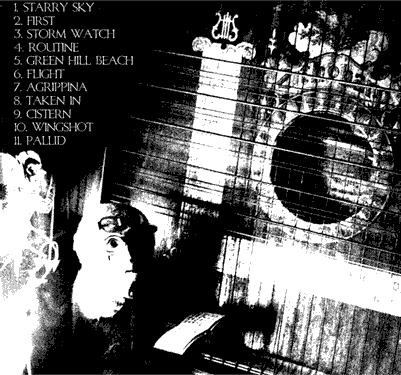
The cd opens with "Starry Sky" which is like listening to a radio broadcast from another time magically intended for your ears only. The next piece "First" opens like a dreamy raga and evolves toward deeper meditations. By the 5th track "Green Hill Beach" we move into a bluesy psychedelic freakout that segues into a quiet electric guitar passage. The 12th track is a mystery track that is reminiscent of Fischbach & Ewing's underground classic 3LP set A Cid Symphony.

This Red Favorite cd is psychedelic folk music at it's purest and resonates a timeless quality to immerse yourself in. For more information please see www.redfavorite.com.

Jeremy is also involved with the cd-r label Elefantplatte Records which is unearthing some very cool seldom heard music from the vaults of the mind. These are the types of projects that I feel like a little kid in a record store when I come across them ... it's a warm glow to know someone is re-discovering this excellent yet obscure music and releasing it in the DIY spirit.

Thursday, August 04, 2005

Psych folk / wyrd folk music part one


The evolution of new Wyrd Folk Music by Mark Coyle

Chapter 1 - Let's Awake The Green Man


With this article we will explore the emergence of a new alternative folk music, often called for want of a better description, ‘
wyrd folk’. This music builds on the foundations of bands like Incredible String Band, Pearls Before Swine and Vashti Bunyan from the 60s and 70s to create a new more personal folk derived music that brings in a range of influences from outside. Often strange, psychedelic, mystical, exploratory and sonically more ambitious than the original form, this music takes the tradition into new realms.

This is not a form of folk music that grew from the folk clubs, reads the folk magazines or has connection or often is more than casually aware of important past and current traditional folk artists. In the strict sense much of it is not traditional folk music as purists would know it, but the instrumentation, crafting of the songs, the telling of stories and the outsider position often adopted all use this form to help the artist express their vision. With the strict need of the media to tag music with genres, we hope that being associated and part of a new folk evolution will help them find natural audience and in turn refresh the music reflecting it’s continuous change over previous decades.

The media overuse of the phrase 'wyrd folk' to try and pigeon hole these artists unduly restricts them and we use the term merely to draw a comparison between the alternative acoustic music of the sixties and the possible similarities of recent artists in intent and sound, even is this is unforeseen and accidental by the artist.

We hope to show in the article that the current explosion of interest in this music is not new but has been evolving for twenty years from the underground. Inevitably we cannot cover every artist in such an article but we have attempted to be reasonably broad in coverage and to give a feeling for the evolution of the genre. Indeed this site was developed to provide a linkage between folk music old and new and to make more explicit its context and relevant to old traditional customs and folklore (of which
more here).

As we explore the new folk related artists we do not support or express any views on the religious, spiritual or political aspects of any artists.

Introduction

In 1980 folk music was withering, the rise in folk rock in the late sixties and early seventies had given rise to some chart success but the commercial focus had moved ever onwards to progressive rock, punk and new wave. In the era of emerging cheap synth-pop and two minute bursts of electric guitar energy folk music suddenly seamed old fashioned. Traditional folk music had continued in the pubs and clubs it’s image by now was of fingers-in-the-ear and beards for the mainstream. Folk music was ignored, ridiculed and deemed irrelevant. As the eighties progressed new wave gave way to indie and power rock and artists such as Shirley Collins retired. A revival in folk music did not seem close at hand....

Psych folk / wyrd folk music part two


The Evolution of New Wyrd Folk Music by Mark Coyle


Chapter 2 - All The Stars Are Waking Now


UK underground artists who appreciated folk music were starting to emerge, informed by interests in the evolution of society, spiritual development, the gothic and sometimes magical exploration.

In particular the inspirational song-writer performer David Tibet previously of Psychic TV and 23 Skidoo with his band-project Current 93 originally created a series of personal, exploratory, atmospheric albums from the mid-1980s onwards that fused folk, gothic (in the original sense of the word), strong use of imagery and experimentation. New comers should check out 1992 album ‘Thunder Perfect Mind’ as good introduction to what became tagged ‘apocalyptic-folk’. So unique and new was his sound and style that it inevitably influenced others both in the UK and overseas. However David Michael (dropping the 'Tibet' name) is now taking Current 93 in a new direction, towards a positive, life embracing approach that moves on from the earlier explorations.

Around this time a number of UK artists emerged with elements of this apocalyptic folk music such as Death In June. Tony Wakeford of the band subsequently left and formed the band Sol Invictus charting his own personal explorations, also playing in Current 93. These artists produce highly conceptualised works that are not folk based but use elements of the form mixed with spiritual and complex political thought. Also worth checking out from this era are The Revolutionary Army Of The Infant Jesus who also produced intoxicated, doom filled folk that is surprisingly Christian in outlook.


Also associated with David Tibet back in the early 1990s and having contributed to Current 93 albums were a number of artists. Fire and Ice is a band led by Ian Read also sometimes of Sol Invictus and Michael Cashmore’s Nature And Organisation. Nature & Organisation did a couple of albums in particular ‘Beauty Reaps The Blood Of Solitude’ which contained dark apocalyptic folk and a definitive version of Willow’s Song from
The Wicker Man at a time when the original was more or less unavailable. Pantaleimon also supported initially by Tibet recorded lovely, largely instrumental albums of drifting, almost ambient folk.

The early imagery of some of the so called 'apocalyptic folk' is based on a feeling that Western society has failed and that rampant capitalism is removing our humanity. They were exploring a feeling that Western society is in a consumer goods fed slumber, removing the free will of the people and hence their ability to realise personal potential. Therefore the people need confronting out of their complacency and to challenge the decline of their society. The decline of the 'West' is at the heart of the music and the alternative model offered by a diverse Europe in contrast to the USA approach is explored. However often all forms of oppression such as political bureaucracy or organised religion are seen as part of the problem. There is a feeling that the simpler forms of existence prior to modern complex society may be a more viable approach to living. This decline of society, a removal of societal structures back to simpler models is the 'apocalypse' at the heart of the music. Over time this generalisation fell away and artists began a long personal journey not only into the state of their external environment but also regarding their own evolution as people, the internal drives and frustrations inherent within them.

It is impossible now to generalise, each artist is expressing a personal approach or ethos. The level of frustration and anger by the artists varies, some use allegorical imagery and a need for spiritual reawakening via non-conformist techniques as their approach. Other are more direct and see this as a battle of wills, showing people the oppressed society they live in via totalitarian imagery, with some artists talking about renewed European war to confront this hypnosis over the populace and revival of 'old' traditional models of living. This is not meant literally in almost all cases but is a symbolic struggle, a call to awakening rather than a crusade.

Exploring sentiments that are meant to be empowering but using confrontational imagery or themes can mean they are interpreted literally and associated with the very topics they decry such as fascism (another organised oppression). To be best of our knowledge this is not the case and they are working at a symbolic level, using techniques to shock people in the same way punk did (which this is in part an enduring continuation). In its own way it's a continuation of the punks using swastikas but usually in a more subtle (and hence easy to confuse) way. We do though we feel that any exploration of a folk 'purity' must be done with caution if at all as it leads towards confused areas that became associated the far-right and nationalism, topics we repudiate at the site (and the musicians themselves are not affiliated with).

We therefore advise people exploring this area of music to set it in the context described above and not to take it as a literal expression of political intent. Indeed these artists often abhor politics themselves and if they have in their impetuous youth been drawn towards extremities of politics and expression, as they mature and leave these flirtations behind they enrich their creativity with a more intelligent, insightful creative debate about the position of modern society.

In terms of the UK, the concept of 'apocalyptic folk' is a broadly historical one, there was never a scene as such, just artists working together who has since developed further. They gradually have each evolved a more personalised expression, often centred around spiritual growth. For example Current 93 themselves quickly left behind these qualities and moved towards personalised, stark folk ballad confessional style that evolved the form in an individual way gradually seeming to grow beyond their early explorations. We particularly look forward to their future output with the focus on a more positive approach.

In mainland Europe an entirely separate area of folk related music emerged which was explicitly more dark by intent, using Norse paganism and seeking a direct link beyond simpler society to ancient, even savage models. This is often called 'folk noir' or even 'black folk' (especially as many of the musicians were previously involved in the black metal area of music). Here it does seem that the artists 'mean it' and their lyrics are all the more disturbing. This is music we feel particularly uncomfortable with and generally do not cover at the site.

The eighties also saw other artists emerge who would prove helpful in bringing forward a climate that would slowly become more receptive to folk music and the psychedelic once again. In the UK Dead Can Dance combined medieval music with elements of folk and soundscapes to help give credibility to a more acoustic, alternative sound. In particular on tracks like 'Black Sun' they were creating a new style of doom filled acoustic music with direct parallels to folk music. Lisa Goddard would go on to solo success, notably on the Gladiator film soundtrack and Brendan Perry works in production and also solo.

Also important then and now was musician Martyn Bates formerly of experimental independent pop band Eyeless In Gaza. From the late 1980s onwards he has combined lonesome avant-folk music with cold isloationist ambience across a wide series of albums. A mid-period album of his that brings together many qualities of his work is ‘Glistening Praise’.

Things had also started to slowly turn in the mid-1980s as some artists sought a different path to the spandex-rock of the time. With acoustic rockers The Waterboys recording a folk oriented album in Fishermen’s Blues and in particular a mystical last track that was a stunning version of W.B. Yeats’ ‘The Stolen Child’. Suicidal Flowers combined sixties garage pop and folk music ballads and other artists emerged later from the festival circuit combining progressive rock, folk touches and celtic or pagan stylings elements such as White Willow and Morrigan developed a new pagan influenced folk-rock music.

In Japan the psychedelic folk band Ghost were starting their long journey into mind melting rock and lysergic folk captured brilliantly on the Pink Floyd-folk combination of 'Snuffbox Immanence' . This Mortal Coil also did a quite sublime version of Tim Buckley’s ‘Song To The Siren’ with Liz Fraser of Cocteau Twins singing that created a new highly atmospheric approach to folk.

Folk music was still a long way from the mainstream but these first formative developments and a revival of interest in artists such as Nick Drake would sow the seeds for the growth to follow.

Note: for much more of this article (four more parts!) please see the Color Wheel blog at www.colorwheeljournal.blogspot.com

Monday, August 01, 2005

Folklore of the Moon - In Gowan Ring


The Folklore of the Moon – May’s “Flower Moon!”

This month’s 3” cd-r offering from Hand / Eye’s subscription series is by “In Gowan Ring” and offers 21 minutes of entrancing and enchanting folk-psych. Five tracks that blend and flow into one another … This is music for an ancient future, or from deep within an oaken grove. In Gowan Ring can be found on the web at
www.ingowanring.com

For more information on the Folklore of the Moon series, contact: Hand/Eye PO Box 131 Glenville PA 17329-0131 or visit www.
somedarkholler.com.

Thursday, July 28, 2005

1040 kHz


Prominent in my record collection is one of only 1,000 copies pressed of Greg Murray's debut 7" vinyl EP released via Elefant Records in Spain. I read about this record some time ago while browsing Tonevendor www.tonevendor.com for new vinyl releases (if you have browsed this blog you probably realize I'm a vinyl junkie) and bought a copy based upon the description alone. Often my intuition pays off and this time was no exception! Greg Murray's songs embody everything I enjoy about indie music - deeply felt lyrics, inventive melodies, songs that keep playing in your head long after the first listening. The first song "Go Honey" is timeless, with a hint of psychedelia that might have been right at home on AM radio back in 1970 yet is completely original and engaging. "Edge" features folk-ish guitar, harmonica, and minimalist druming that weave together perfectly. All four songs on this EP illuminate and expand one's musical consciousness. Greg has recorded several other EPs (equally excellent) and a more recent full-length CD "Tymes Ten". For more information including free MP3s (thank you!) check out Greg's informative and comprehensive website at www.gregmurray.co.uk

Thursday, July 21, 2005

The One AM Radio


One of the things I hope to accomplish with this blog, as well as my radio broadcasts, is to broaden readers' / listeners musical horizons. I want to turn people on to the very overlooked indie "band" The One AM Radio. The One AM Radio is the moniker of songwriter / musician Hrishikesh Hirway & occasional guests. His songs are heartfelt, introspective, bordering on melancholy and minimalism ... with beautiful melodies and sentiments, sometimes swells of strings or (mostly) unintrusive electronic effects.

I've managed to obtain most of The One AM Radio's recordings (several are out of print). "Night Falls" is my favorite, a split CD-EP with the Wind-Up Bird and its standout track "All That I Can Recall Is the Haunting":

i could not see the horizon
the seas had swallowed up the skies
the wind died down, and the world turned silent
the fog rolled back before my eyes
diffuse blue light swelled all around us
like water at once both clear and deep
i called to you over and over,
but you would not come out from sleep
voices rose up in a chorus
in a song of longing and what could be
i closed my eyes, but i could see you
oh Light, please stay with me.

For more info on The One AM Radio including mp3 downloads visit
www.theoneamradio.com

Wednesday, July 20, 2005

Radio Free Brattleboro cd


Given everything that Radio Free Brattleboro is going through right now, it would be a good time to show them some support & pick up a copy of the RFB Live In-Studio Performances CD available at
www.cdbaby.com This compilation has been a favorite of mine since its release and includes the following tracks:


1) Smiley Bob Project - Radio Free
2) Paul Barrere & Fred Tackett of Little Feat - Down on the Farm
3) Greg Brown - Bucket
4) Louise Taylor - Call My Name
5) Darryl Purpose - A Crooked Line
6) Bethanie w/Phil Bloch - Water Run Deep and Wide
7) Adrian Crowley - A Northern Country
8) Derrik Jordan - Invitation to Ecstasy
9) John Hughes - Bamba Bojang
10) California Guitar Trio - Circulation
11) Euphony Groove - Bemoan
12) Ill Wind Ensemble - Broken Chord
13) Elevator Tribe - Static Between the Stations
14) Mountain of Venus - The Bridge
15) Relative Strangers - Same Undone
16) Gordon Stone & Michael Daves w/Phil Bloch - Sunday Driver
17) Dexter Grove - 3 am
18) Reed Foehl & Putnam Murdock - Come September
19) The Mammals - Quite Early Morning

Every track on this compilation is excellent. It starts out with a rolicking free radio folk anthem by the Smiley Bob Project which I have played many times on Seldom Heard Radio & the cd just evolves from there. With music as diverse and enjoyable as this emanating from the airwaves, radio is alive again. Alas, the fate of Radio Free Brattleboro hangs in the balance
of the courts. For the latest: www.rfb.fm

The history and evolution of Seldom Heard Radio part one

Deep in the recesses of my childhood memories, I spent many hours exploring my father’s “cavern” in the basement of our suburban house – his electronic repair shop, which smelled of must and damp and solder. His work benches were strewn with the chasis of televisions & radios, and mysterious tubes of all sizes. At some point in my early childhood – I think it was around the age of eight, I simultaneously started collecting 7” vinyl records (the first record I ever bought was Atlantis by Donovan)… and heard a shortwave radio which had been brought in for repairs. The deep tones and unfamiliar languages intrigued me, as did the static and strange noises between the stations. The airwaves were alive.

This is one of the hazards of starting a “blog” … it’s part journal, part news, part advocating. This whole musing was triggered by a letter from John Campbell of Devon, UK who heard Seldom Heard Radio on 6235 kHz in April via Jolly Roger Radio International in Ireland. He said, in part “I’ll be very interested in … any information about the history and style of programming of your station …”Alas, John, you may get more information in these posts than you expected!

My initial encounter with shortwave was quickly forgotten, unfortunately, as I focused on “dx’ing” (distance listening) medium wave (AM band) stations in the US. As a child I spent hours tuning in stations from as far away as Chicago, Baltimore, Detroit, Nashville, Canada and even Mexico. Around this time, my local AM station, WFEA had a sort of underground 60s pop and rock format, and I became determined to hang out at the station if I could. I rode the five miles across the river on my bike, and found that a couple of DJs would actually talk to me! Years later I learned that my father had played cowboy music live on WFEA in the late 1930s before he was stationed in India during World War II..

As I became ten, eleven, twelve, friends of mine & I would play “DJ”, rigging up homemade Radio Shack transmitters, or recording music and shows onto monolithic tape recorders. Back then we could get an AM signal out almost a quarter of a mile by rigging our crystal set … and we were triumphant. Thus the seeds of Seldom Heard Radio were planted …

Monday, July 18, 2005

The history and evolution of Seldom Heard Radio part two


In the summer of 1977, I spent two months at the University of New Hampshire taking summer courses. Immediately, I gravitated toward the radio station, WUNH, which I discovered was being run by a scruffy looking guy with a two day old beard who didn’t speak much but would run in every few minutes to throw on another record. When I offered to help him out, he was thrilled --- I could play any music I wanted but had to play requests if anyone called. No problem.


I felt like I had just been handed the keys to the kingdom and embarked on doing something I always wanted to do if given the chance to be a DJ --- play entire LPs at a time. So listeners to 91.3 that summer were treated to my already eclectic taste in music --- From the Mars Hotel by the Grateful Dead … Mike Oldfield’s Tubular BellsEat a Peach by the Allman Brothers … Bob Dylan’s Blood on the Tracks … the phone rang several times a day but not for requests … people were calling thanking me for playing certain LPs or just for playing music they couldn’t hear on other stations. I was delighted.

By 1978 I was becoming a serious teenager and thinking of college, work, and more work. I didn’t have much to do with radio except for listening to WSLE, a freeform community station in Peterboro NH, where in the course of an hour one could hear local musicians, acoustic music, celtic, reggae, rock, and even jazz. It was sweet bliss until WSLE was sold in 1981 and the format changed to … disco! There was so much outrage from listeners in New Hampshire and Vermont that a non-profit was formed, Concerned Citizens for Responsible Radio, to protest the sale and see what could be done to restore WSLE to its rightful “format”. Legend has it that Tim Tobin, one of the WSLE DJs, on his last shift played “Stairway to Heaven” and drove away from the studio, letting the turntable drift out to the LP’s end grooves, and all that could be heard on the frequency (92.1) until the new station owner arrived was the steady static of ‘click click click’ at the end of the record.


The Seldom Heard Radio story picks up again in 1999 … but that’s another post.

The history and evolution of Seldom Heard Radio part 3

In Y2K, the Universe converged to lead me back to my intrigue with radio. Quite by accident, in the early part of the year, I noticed a program guide for the local college station, WSCS, in the weekly shopper that arrives in the mail like clockwork each Thursday. I had never heard of WSCS and decided to give the station a listen. Looking over the program schedule I was hooked --- no commercials, new age and celtic music, folk shows, WSCS had to be special. And I felt I had something to offer via my eclectic knowledge of music.

I wrote a letter to the Program Director offering my services as a volunteer DJ. Within a week, he called, we arranged to meet, and before I knew it, I was trained in the stations policies and equipment and running a broadcast of my own every Sunday.

But what to call the show? Color Wheel Radio (after the literary journal I co-edit)? I wanted to play mostly obscure music, artists rarely heard on the airwaves. Numerous names floated through my mind … then I thought (bizarrely) of a old bluegrass / country band called the Seldom Scene … and since the music I wanted to feature was seldom heard … the pun stuck and the name was born. Life was good, the tunes were awesome, and little did I realize the realm of shortwave radio was waiting for my rediscovery …

The history and evolution of Seldom Heard Radio part four

Just as Seldom Heard Radio was debuting on WSCS in 2000, I was re-connecting and rediscovering the magic of radio on so many levels --- learning about propagation, the physical properties of electricity, production of radio waves, etc … I started researching radio stations and broadcasting alternatives around the world … and rediscovered shortwave listening.

My first shortwave radio was a Radio Shack DX 394 which miraculously brought back all of the bleeps and squelches and static-filled sizzles of my childhood radios. Within weeks I decided that I had to bring Seldom Heard Radio and other projects to the shortwave spectrum. Within another few weeks I was creating programs for broadcast on WBCQ The Planet (7415 kHz) and WRMI (7385 kHz). These were very low-tech homemade shows full of obscure music and minimal announcing. On WRMI I experiment with other formats including co-producing a show called "The Drive-In Double Feature" with DIY shortwave host B-Movie Bob, where we played and discussed music from B movies of the 50s, 60s & 70's.


Listener response was sporadic yet positive, and soon I had extended Seldom Heard Radio to shortwave in Europe via Radio 510 International. From Europe, the floodgates of listener feedback opened, and I received dozens of letters from happy (if somewhat musically perplexed and bewildered) listeners. Correspondence arrived from Germany, Sweden, Norway, Italy, England, Belgium, the Netherlands. People in Europe seem to take radio more seriously, and, also seem more motivated to make it more of a two-way exchange of communication. I was delighted.

Over the course of a few short years life and activity and energy levels intervened and I decreased the shortwave broadcasts to focus on production of my local FM program. Yet Seldom Heard Radio was going to evolve again … via the internet and Radio Lavalamp. Stay tuned for that chapter … and more.

Sunday, July 17, 2005

Dx'ing with Cumbre


Part of the purpose of this blog is to encourage people to learn about and take an interest in shortwave radio. One of the best programs in production related to what's happening in shortwave is Dx'ing with Cumbre. The show is hosted by Marie Lamb and contains a wealth of listening tips and up-to-date information on stations and programs broadcasting on the shortwave spectrum. For more information surf to www.cumbredx.org on where and when you can hear this weekly program or for streaming audio.

Media Minutes

Every week during my broadcast I include the five minute news update called Media Minutes. Hosted by John Anderson and Kimberlie Kranich, Media Minutes focuses on the latest info regarding FCC regulations and policies, legislative and legal issues, Low Power FM stations, PBS and NPR, telecommunications coporations, microbroadcasting, and trends in commercial and non-commercial media. The program is free to download at www.freepress.net.

Wednesday, July 13, 2005

WOOL Black Sheep Radio


While the news from Brattleboro is grim, with Radio Free Brattleboro still off the air, just a few miles north on Rte 91 in Vermont the community of Bellows Falls has a new licensed LPFM station broadcasting at 100.1. WOOL! check them out at www.wool.fm. Their website contains in depth info on the organization and happenings at the station. Congratulations, WOOL!

Revenge of the Lawn?

Many years ago I watched a documentary called “Lawns” on PBS and was fascinated by people’s obsession with their yards. Although I had done my share of yardwork in my life, was even part of a groundskeeping crew once in my youth, I never developed this affinity with having the perfect yard. Watching this program, the infinite variety of grasses, care techniques, tools, landscape designs were staggering. Yet everyone they interviewed seemed so rigid about their lawn care routines and practices, it was almost frightening. In fact they showed one home with a ‘natural’ lawn … people who believed nature was intended to be its own creation, to flourish without human intervention. Their neighbors almost unanimously despised this couple, or assume they were lazy or uncaring about the community, simply because their lawn was different. An eyesore, they called it. One neighbor on their block commented “well, it’s a free country” and that’s about as much support as that couple ever got.

In the never-ending battle with lawnmowers and weed whackers, I’m the losing party. Every single time I get my lawn mower repaired, it dies again within minutes. When it is functioning properly, we get a week of rain. The weed whacker was running just fine until it ran out of twine. Upon my arrival back from the hardware store I learned the motor had seized up somehow.

My neighbors on the right, left, and across the street amaze me with their riding mowers. Every man on this street owns a riding lawn mower other than me! How do they afford it? Their shiny green John Deeres look as if they had been just moments ago been driven out of the showroom. And these men are outside mowing practically every single day! Rain, shine, wind, bitter cold, humidity, one-hundred degrees … they tend their lawns as if they are shrines to civilization itself, as if the whole social order would collapse if a single blade of grass were left uncut. Where do these men find all this time to lavish on their lawns when they have businesses, children, lives to pursue? I wonder if they pay as much rapt attention to their kids’ and spouses’ needs.

Around the same time as seeing the Lawns documentary on PBS I watched another documentary on PBS called Sherman’s March. It was filmed by Ross McElwee, who had intended to walk in the footsteps of General Sherman’s armies and document the still-lingering effects of the civil war over a century later. Instead, his girlfriend broke up with him just prior to filming and the project became an odyssey of introspection and documenting his feelings as he traveled. The effect is brilliant. Through McElwee’s cinema verite style we discover his flaws, his idealization of women, his longing for companionship yet reserved, aloof, self-absorbed nature.

One minor point of the film showed a group of men who had some other fixation with lawns – specifically lawn ornaments. In the stealth of night, they would sneak into one another’s yards and steal lawn decorations. These were not just any lawn ornaments, these were giant plastic and plaster large-as-life representations of dinosaurs, elephants, moose, and other wild animals. I guess this was a whole new spin on the ‘steal the garden gnome’ phenomenon.


The pirate spirit inside me was laughing as I watched these men make their strategies and in the cover of darkness wrestle gigantic icons into pickup truck beds and trailers. No doubt it was a fun game, knowing that tomorrow, your buddy just might sneak off with your favorite tyrannosaurus from beside the pool, or your entire mutant flamingo collection, and you might have to triple your vigilance. Now that kind of activity could make me fond of lawns, and their keepers.

Sunday, July 10, 2005

Musings from a Saturday Afternoon

Every Saturday afternoon at 2 pm I drive the 20 miles along route 103 then route 114 to Henniker NH from beautiful downtown Warner. The route is thankfully a scenic one with minimal traffic, and on a sun-filled day is a refreshing and engaging opportunity to contemplate what I will do during the broadcasts each week.

Part of me holds a pirate's spirit, and if ever there were an 'almost' pirate station, it is WNEC. Yes it is licensed by the Federal Communications Commission, yet the station is hardly ever on the air. In fact, perusing the station log today revealed that WNEC had been off the air since last Saturday at 9 pm when Kristin, WNEC's music director, signed off for the evening.

As my shift progressed, and I was sinking into the sublime groove of jazzy tunes (a kind of different mood for my shows), I realized the right channel indicator was not moving. Checking the radio outside the broadcast booth, the LED display confirmed only one channel was being received. So, if anyone was listening, they would hear the program in monaural at best and through only one speaker at worst. A discussion with Kristin revealed that the station also had this technical glitch this last week. She left a note for the station manager but nothing had been done. I was assured this technical difficulty could continue for weeks or months without intervention. My memory flashed back to a series of months when WNEC was only audible as far as the parking lot.

The phone is usually quiet when I'm on the air. I wonder who, if anyone, is listening. And if someone is listening, are they catching the vibe I'm sending out? Do they feel the intent behind the flow of music, the smattering of media news that I read, the frequent references to 'free' radio?

WNEC is a 150 watt station and my Grundig 800 picks the signal up crisp and clear at home, some 14 miles away (as the crow flies). There is something primal and beautiful about radio signals and hearing stations that are ephemeral ... there ... and then gone. That's what attracts me to pirate radio and shortwave listening. WNEC embodies the "FM" version of that primal attraction. A reminder that not everything is perfectly timed or scheduled in the world, that honest media is fragile, a product of human hands and hearts. Sometimes the silences between transmissions are more powerful than sound itself.

Moondog!


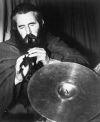
Moondog was a street musician and poet who hung around the 52nd to 54th Street area and around the old Madison square Garden in Manhattan in the 40's and 50's, through to the 70's. He often dressed in Viking regalia considering himself to be Nordic in sensibility. His costume would consist of homemade robe, sandals, a flowing cape, a horned Viking helmet, with a long spear of his own manufacture in his hand. Passers-by called him "the Viking of Sixth Avenue". Reaction to this garb was to hamper his musical development due to him being considered a crank. In later years he was persuaded to abandon it for more conventional dress (by his own admission, this was a good move). He was a mainly self-taught composer who worked with home made instruments and produced eccentric jazz and classical based pieces as well as vocal rounds. Part of the charm of his work is the brevity of much of it.

He was born, Louis Hardin, in Marysville, Kansas on May 26, 1916 but his family moved to Wyoming. He was interested in drums and drum rhythms from an early age. He played drums in Hurley High School in 1929 and in 1949, he played tomtom and flute at a Sun Dance held by the Blackfoot in Idaho. By then he was already blind as he lost his sight in his early teens when a dynamite cap exploded. He studied music and finished high school at the Iowa School for the Blind, and in 1933 studied braille at the Missouri School for the Blind in St. Louis. He composed all his pieces in braille.

In 1942 Hardin got a scholarship to study in Memphis but he mostly taught himself ear training and other musical skills and theory from books in braille. In 1943, he came to New York and met Artur Rodzinski, Leonard Bernstein, and Toscanini. Supposedly he bowed to kiss Toscanini's hand but Toscanini pulled it away saying,' I am not a beautiful woman '. Hardin also began to meet jazz performers such as Charlie Parker and Benny Goodman. This gave his work a jazz feel which together with a certain beat quality in the form of humorous philosophical statements and the use of background sounds gives makes him a true eccentric.
Hardin began to call himself Moondog from 1947 in honor of a dog "who used to howl at the moon more than any dog I knew of".

Despite his status as street musician he intermittently recorded for the CBS, Prestige, Epic, Angel and Mars labels. One of his songs, "All Is Loneliness," (on "More Moondog" for Prestige and "Moondog 2" on CBS) was recorded by Janis Joplin. He also wrote music for radio and television commercials, and his music was used on the soundtracks for Jack Nicholson's "Drive, He Said," and the Coen Brothers "Big Lebowsky". Moondog also worked on an album of "Mother Goose Songs" with Julie Andrews. He was also feted by jazz musicians - Benny Goodman, Charlie Parker, 50's beat poets and 60s flower children. His CBS "Moondog" album came about when James William Guercio - producer of Chicago and director of cult film "Electra Glide in Blue" - heard him and decided to record him. Moondog was also interviewed on many television shows, including both "Today" and "The Tonight Show."

In the fifties Moondog sued the disc jockey Alan Freed, the rock and roll king. Freed used the name Moondog as well as one of his records because it had a howling wolf in it. Then, when he came to New York, he had a program called the Moondog Show. Moondog won the case and Freed stopped using the name. There is a rumour that Stravinski intervened by speaking to the judge.

Moondog disappeared from the streets of New York in 1974 because he had been invited to perform in Germany. After his performances in Hamburg, he began to perform on the streets of Europe where he met Mrs. Sommer who transcribed his music and acted as his publisher and business manager. Her father supported Moondog in his later years. He produced at least five albums in Europe, including a "sound saga" titled "The Creation," and regularly performed his compositions with chamber and symphony orchestras in Paris, Stockholm and cities in Germany. Moondog died of heart failure on Wednesday, September 8, 1999 in a hospital in Munster, Germany. He was 83.

Friday, July 01, 2005

800 kHz

Why I hope some people are reading this blog … and why I hope some people aren’t

It’s true. Writers don’t write just for themselves. They write to be read by others; even if it is one other person. This blog is a way of sharing some of my off-center interests with you … yes you! You in specific! If you’re reading this blog, then my hope is you have at least some interest in one of the following topics: indie music, free radio, pirate radio, community media, freedom and democracy, the earth we live upon, the moon and stars, art, cool ideas, and making the world a better place (however you define that) ...

However, if you’re not reading this blog, I’m even more pleased. The fact that you’re not connected to the internet is awesome. Yes, technology is wonderful in appropriate doses and usages. Yet neither technology nor information are going to save the human race. Only we can do that, by the grace of the gods and goddesses. It comforts me to no end to know that somewhere someone is listening to old 78’s on a record player … or tuned into a shortwave radio … or writing / sketching in a leather bound paper journal … or telling a story to children … or pulling weeds in the garden … or writing a real letter with textured paper and pen ... or publishing a handmade zine or chapbook … I don’t want the world to be totally technologized, owned by corporations, branded, etc. When we teach our children and grandchildren about the world, it should be about human experiences, ones we can touch and taste and smell, not about a world full of laptops and cell phones and tivo. So thank you, thank you for not reading this blog.

Saturday, June 25, 2005

An introduction to Longwave frequencies

"Longwave" refers to all frequencies below the lower end of the AM broadcasting band at 540 kHz. The lower limit of what frequencies constitute "radio" is not precisely defined, but 5 kHz is a widely accepted starting point for the radio spectrum.

For many years, radio hobbyists ignored longwave because most commonly available communications receivers only tuned down to 540 kHz. However, most new receivers today tune down to at least 150 kHz and longwave DXing is enjoy new popularity.

One big problem when tuning longwave is electrical noise from power lines, electrical devices, motors, etc. Longwave is far more susceptible to such noise than higher frequencies, and you might hear only a loud "buzz" when you tune across longwave from your location. Also, static crashes from thunderstorms can be severe, especially in summer. To combat noise, many longwave DXers use an indoor "loop" antenna that allows rejection of nearby electrical noise sources. Other longwave DXers use special phasing units to reduce noise levels.

Reception distance on longwave is similar to that on the AM broadcast band, as are reception patterns. Greater range is possible when the signal is reaching you over a water path, as is often the case in coastal regions. At night, reception of stations from hundreds or even thousands of miles away is possible. Night reception on longwave is better in winter than in summer, and the equinoxes often give the best propagation.

Unlike the shortwave frequencies above 1700 kHz, the longwave spectrum is allocated on a more "ad hoc" basis, with different users and services frequently sharing the same frequency range. Here is a general description of the world below 540 kHz:

Below 155 kHz: Signals below 155 kHz don't propagate very well via the ionosphere; the absorption is too great even at night during winter. These signals can travel for thousands of miles via ground wave, but high transmitter powers are required. Signals at very low frequencies, about 50 kHz and lower, can penetrate sea water very well. As a result, these frequencies are used by military forces of the major powers, especially for communication with submarines. The U.S. Navy's "Omega" navigation system is found on 10.2, 12, and 13.6 kHz. The Russian navy operates a similar system on 15.62 kHz. The U.S. Air Force has a FSK-based communications system on 29.5 and 37.2 kHz. This system was established to provide a backup in case nuclear explosions rendered the ionosphere useless for propagation. Miscellaneous FSK-based stations are found here for direct communications with submarines and naval forces.

150 to 175 kHz: In the United States, this range is used by the U.S. Air Force's ground wave emergency network (GWEN), a packet-based network to provide communications during a nuclear war. Transmitters are kept continuously operational here on a "standby" basis, and it's easy to hear their loud, "raspy" signal bursts.

155 to 281 kHz: This is another AM broadcasting band in Europe and parts of Asia. In Europe, there are numerous high powered (1,000,000 watts or more) stations here. These stations are capable of covering an entire European nation like France or Germany with reliable signals around the clock. Although ionospheric propagation is not good at these frequencies, the high powers used means that many of these broadcasters can be heard along the Atlantic seaboard during the fall and winter. Best reception is usually from local sunset to about 0600 UTC. A few longwave stations in Asiatic Russia can be heard on the Pacific Coast beginning an hour or so before local sunrise.

160 to 190 kHz: In the United States, this range is open to unlicensed experimental transmissions. Transmitter power is restricted to one watt, and the maximum antenna length (including feedline) can be no more than 50 feet. Any mode can be used. Some of these "lowfer" (as they are known) unlicensed stations have been heard several hundreds of miles away under favorable conditions.

200 to 430 kHz: This range is used mainly by navigation beacons, which continuously repeat their call signs in Morse code. Call signs do not follow the international allocations given elsewhere on this site. Instead, the call signs usually give an idea of the location of the beacon. For example, beacon "FT" on 365 kHz is located at Fort Worth, Texas.

430 to 500 kHz: This range is used for two-way Morse code communications between ships at sea and shore stations. Shore stations use three-letter callsigns, while ship station callsigns consist of four letters. All callsigns are from international allocations. The number of stations you can hear in this range is rapidly declining due to a shift in maritime communications to satellites and shortwave frequencies. After February, 1999, radio operators skilled in Morse code will no longer be required on ships sailing in international waters, and the number of stations you can hear in this range should drop precipitously after that date.

500 kHz: This is an international ship calling and distress frequency for maritime communications in Morse code. It is very lightly used, and after February, 1999, ship stations and shore stations will no longer be required to monitor this frequency for calls.

500 to 540 kHz: This segment is populated by miscellaneous beacons and stations. Perhaps the most interesting frequency here is 518 kHz, used for transmission of maritime safety and navigation information via FSK. This system is known as NAVTEX, and includes weather bulletins as well as notices of missing and overdue vessels. 530 kHz is used in the United States and Canada for low powered road and traffic information broadcasts.

Tuesday, June 21, 2005

750 kHz

750 kHz- an introduction to the Seldom Heard Radio blog

Every venture starts at a point of origin, and my venture into the world of blogging starts here. Why a blog? I much prefer the written page and textured paper to the ephemeral world of internet technology. I’ve decided that Seldom Heard Radio needs a presence in the electronic community so I can share thoughts, resources, and creative work & ideas with others. This blog will focus on non-commercial radio, independent music (including some of my personal favorite, the realm of what is sometimes called "psychedelic folk") and occasional news and rantings regarding my show called "Seldom Heard Radio" which is heard on WSCS 90.9 (www.colby-sawyer.edu/wscs in New London NH and WNEC 91.7 in Henniker NH (www.nec.edu)

In New Hampshire there are very few alternatives to commercial radio. There is New Hampshire Public Radio http:/nhpr.org which is about as bland as public radio gets - there is only one music show and it's a boring traditional folk music show on Sunday nights. The rest is talk talk talk ... and very little listening to the audience. Only an hour and a half per day is devoted to topics of New Hampshire interest. "Public Radio" should rightly be called "partially public-funded radio" ... or "partly corporate sponsored radio" ... meeting local public need has little to do with it. I would rather listen to "public access" radio broadcasting if it existed --- frequencies where many diverse voices could be heard. I'll be the first to admit I know very little about podcasting, which seems in spirit similar to public access, though it is "narrowcasting" rather than "broadcasting". To listen to podcasts one must own the right equipment, a computer, etc. To listen to a radio broadcast, all one needs is a radio with an antenna and a power source (or not - some radios are solar or wind-up).Maybe narrowcasting is the future --- ever smaller audiences as we all become more active in creating our own media. The state of media is in flux right now, it is the most exciting time in radio history since Marconi received the letter 'S' in Morse code across the Atlantic. The possibilities for creating diversity are opening all around us even as commercial radio becomes more and more homogenized, monosyllabic and bland. So this is my first attempt at a web presence for Seldom Heard Radio. Please stay tuned.