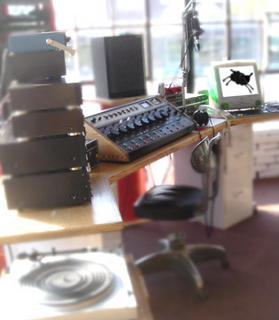
 While the news from Brattleboro is grim, with Radio Free Brattleboro still off the air, just a few miles north on Rte 91 in Vermont the community of Bellows Falls has a new licensed LPFM station broadcasting at 100.1. WOOL! check them out at www.wool.fm. Their website contains in depth info on the organization and happenings at the station. Congratulations, WOOL!
Many years ago I watched a documentary called “Lawns” on PBS and was fascinated by people’s obsession with their yards. Although I had done my share of yardwork in my life, was even part of a groundskeeping crew once in my youth, I never developed this affinity with having the perfect yard. Watching this program, the infinite variety of grasses, care techniques, tools, landscape designs were staggering. Yet everyone they interviewed seemed so rigid about their lawn care routines and practices, it was almost frightening. In fact they showed one home with a ‘natural’ lawn … people who believed nature was intended to be its own creation, to flourish without human intervention. Their neighbors almost unanimously despised this couple, or assume they were lazy or uncaring about the community, simply because their lawn was different. An eyesore, they called it. One neighbor on their block commented “well, it’s a free country” and that’s about as much support as that couple ever got.
In the never-ending battle with lawnmowers and weed whackers, I’m the losing party. Every single time I get my lawn mower repaired, it dies again within minutes. When it is functioning properly, we get a week of rain. The weed whacker was running just fine until it ran out of twine. Upon my arrival back from the hardware store I learned the motor had seized up somehow.
My neighbors on the right, left, and across the street amaze me with their riding mowers. Every man on this street owns a riding lawn mower other than me! How do they afford it? Their shiny green John Deeres look as if they had been just moments ago been driven out of the showroom. And these men are outside mowing practically every single day! Rain, shine, wind, bitter cold, humidity, one-hundred degrees … they tend their lawns as if they are shrines to civilization itself, as if the whole social order would collapse if a single blade of grass were left uncut. Where do these men find all this time to lavish on their lawns when they have businesses, children, lives to pursue? I wonder if they pay as much rapt attention to their kids’ and spouses’ needs.
Around the same time as seeing the Lawns documentary on PBS I watched another documentary on PBS called Sherman’s March. It was filmed by Ross McElwee, who had intended to walk in the footsteps of General Sherman’s armies and document the still-lingering effects of the civil war over a century later. Instead, his girlfriend broke up with him just prior to filming and the project became an odyssey of introspection and documenting his feelings as he traveled. The effect is brilliant. Through McElwee’s cinema verite style we discover his flaws, his idealization of women, his longing for companionship yet reserved, aloof, self-absorbed nature.
One minor point of the film showed a group of men who had some other fixation with lawns – specifically lawn ornaments. In the stealth of night, they would sneak into one another’s yards and steal lawn decorations. These were not just any lawn ornaments, these were giant plastic and plaster large-as-life representations of dinosaurs, elephants, moose, and other wild animals. I guess this was a whole new spin on the ‘steal the garden gnome’ phenomenon.
The pirate spirit inside me was laughing as I watched these men make their strategies and in the cover of darkness wrestle gigantic icons into pickup truck beds and trailers. No doubt it was a fun game, knowing that tomorrow, your buddy just might sneak off with your favorite tyrannosaurus from beside the pool, or your entire mutant flamingo collection, and you might have to triple your vigilance. Now that kind of activity could make me fond of lawns, and their keepers.
Every Saturday afternoon at 2 pm I drive the 20 miles along route 103 then route 114 to Henniker NH from beautiful downtown Warner. The route is thankfully a scenic one with minimal traffic, and on a sun-filled day is a refreshing and engaging opportunity to contemplate what I will do during the broadcasts each week.
Part of me holds a pirate's spirit, and if ever there were an 'almost' pirate station, it is WNEC. Yes it is licensed by the Federal Communications Commission, yet the station is hardly ever on the air. In fact, perusing the station log today revealed that WNEC had been off the air since last Saturday at 9 pm when Kristin, WNEC's music director, signed off for the evening.
As my shift progressed, and I was sinking into the sublime groove of jazzy tunes (a kind of different mood for my shows), I realized the right channel indicator was not moving. Checking the radio outside the broadcast booth, the LED display confirmed only one channel was being received. So, if anyone was listening, they would hear the program in monaural at best and through only one speaker at worst. A discussion with Kristin revealed that the station also had this technical glitch this last week. She left a note for the station manager but nothing had been done. I was assured this technical difficulty could continue for weeks or months without intervention. My memory flashed back to a series of months when WNEC was only audible as far as the parking lot.
The phone is usually quiet when I'm on the air. I wonder who, if anyone, is listening. And if someone is listening, are they catching the vibe I'm sending out? Do they feel the intent behind the flow of music, the smattering of media news that I read, the frequent references to 'free' radio?
WNEC is a 150 watt station and my Grundig 800 picks the signal up crisp and clear at home, some 14 miles away (as the crow flies). There is something primal and beautiful about radio signals and hearing stations that are ephemeral ... there ... and then gone. That's what attracts me to pirate radio and shortwave listening. WNEC embodies the "FM" version of that primal attraction. A reminder that not everything is perfectly timed or scheduled in the world, that honest media is fragile, a product of human hands and hearts. Sometimes the silences between transmissions are more powerful than sound itself.
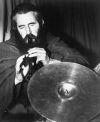 Moondog was a street musician and poet who hung around the 52nd to 54th Street area and around the old Madison square Garden in Manhattan in the 40's and 50's, through to the 70's. He often dressed in Viking regalia considering himself to be Nordic in sensibility. His costume would consist of homemade robe, sandals, a flowing cape, a horned Viking helmet, with a long spear of his own manufacture in his hand. Passers-by called him "the Viking of Sixth Avenue". Reaction to this garb was to hamper his musical development due to him being considered a crank. In later years he was persuaded to abandon it for more conventional dress (by his own admission, this was a good move). He was a mainly self-taught composer who worked with home made instruments and produced eccentric jazz and classical based pieces as well as vocal rounds. Part of the charm of his work is the brevity of much of it.
He was born, Louis Hardin, in Marysville, Kansas on May 26, 1916 but his family moved to Wyoming. He was interested in drums and drum rhythms from an early age. He played drums in Hurley High School in 1929 and in 1949, he played tomtom and flute at a Sun Dance held by the Blackfoot in Idaho. By then he was already blind as he lost his sight in his early teens when a dynamite cap exploded. He studied music and finished high school at the Iowa School for the Blind, and in 1933 studied braille at the Missouri School for the Blind in St. Louis. He composed all his pieces in braille.
In 1942 Hardin got a scholarship to study in Memphis but he mostly taught himself ear training and other musical skills and theory from books in braille. In 1943, he came to New York and met Artur Rodzinski, Leonard Bernstein, and Toscanini. Supposedly he bowed to kiss Toscanini's hand but Toscanini pulled it away saying,' I am not a beautiful woman '. Hardin also began to meet jazz performers such as Charlie Parker and Benny Goodman. This gave his work a jazz feel which together with a certain beat quality in the form of humorous philosophical statements and the use of background sounds gives makes him a true eccentric.
Hardin began to call himself Moondog from 1947 in honor of a dog "who used to howl at the moon more than any dog I knew of".
Despite his status as street musician he intermittently recorded for the CBS, Prestige, Epic, Angel and Mars labels. One of his songs, "All Is Loneliness," (on "More Moondog" for Prestige and "Moondog 2" on CBS) was recorded by Janis Joplin. He also wrote music for radio and television commercials, and his music was used on the soundtracks for Jack Nicholson's "Drive, He Said," and the Coen Brothers "Big Lebowsky". Moondog also worked on an album of "Mother Goose Songs" with Julie Andrews. He was also feted by jazz musicians - Benny Goodman, Charlie Parker, 50's beat poets and 60s flower children. His CBS "Moondog" album came about when James William Guercio - producer of Chicago and director of cult film "Electra Glide in Blue" - heard him and decided to record him. Moondog was also interviewed on many television shows, including both "Today" and "The Tonight Show."
In the fifties Moondog sued the disc jockey Alan Freed, the rock and roll king. Freed used the name Moondog as well as one of his records because it had a howling wolf in it. Then, when he came to New York, he had a program called the Moondog Show. Moondog won the case and Freed stopped using the name. There is a rumour that Stravinski intervened by speaking to the judge.
Moondog disappeared from the streets of New York in 1974 because he had been invited to perform in Germany. After his performances in Hamburg, he began to perform on the streets of Europe where he met Mrs. Sommer who transcribed his music and acted as his publisher and business manager. Her father supported Moondog in his later years. He produced at least five albums in Europe, including a "sound saga" titled "The Creation," and regularly performed his compositions with chamber and symphony orchestras in Paris, Stockholm and cities in Germany. Moondog died of heart failure on Wednesday, September 8, 1999 in a hospital in Munster, Germany. He was 83.
Why I hope some people are reading this blog … and why I hope some people aren’t
It’s true. Writers don’t write just for themselves. They write to be read by others; even if it is one other person. This blog is a way of sharing some of my off-center interests with you … yes you! You in specific! If you’re reading this blog, then my hope is you have at least some interest in one of the following topics: indie music, free radio, pirate radio, community media, freedom and democracy, the earth we live upon, the moon and stars, art, cool ideas, and making the world a better place (however you define that) ...
However, if you’re not reading this blog, I’m even more pleased. The fact that you’re not connected to the internet is awesome. Yes, technology is wonderful in appropriate doses and usages. Yet neither technology nor information are going to save the human race. Only we can do that, by the grace of the gods and goddesses. It comforts me to no end to know that somewhere someone is listening to old 78’s on a record player … or tuned into a shortwave radio … or writing / sketching in a leather bound paper journal … or telling a story to children … or pulling weeds in the garden … or writing a real letter with textured paper and pen ... or publishing a handmade zine or chapbook … I don’t want the world to be totally technologized, owned by corporations, branded, etc. When we teach our children and grandchildren about the world, it should be about human experiences, ones we can touch and taste and smell, not about a world full of laptops and cell phones and tivo. So thank you, thank you for not reading this blog.
"Longwave" refers to all frequencies below the lower end of the AM broadcasting band at 540 kHz. The lower limit of what frequencies constitute "radio" is not precisely defined, but 5 kHz is a widely accepted starting point for the radio spectrum. For many years, radio hobbyists ignored longwave because most commonly available communications receivers only tuned down to 540 kHz. However, most new receivers today tune down to at least 150 kHz and longwave DXing is enjoy new popularity.
One big problem when tuning longwave is electrical noise from power lines, electrical devices, motors, etc. Longwave is far more susceptible to such noise than higher frequencies, and you might hear only a loud "buzz" when you tune across longwave from your location. Also, static crashes from thunderstorms can be severe, especially in summer. To combat noise, many longwave DXers use an indoor "loop" antenna that allows rejection of nearby electrical noise sources. Other longwave DXers use special phasing units to reduce noise levels.
Reception distance on longwave is similar to that on the AM broadcast band, as are reception patterns. Greater range is possible when the signal is reaching you over a water path, as is often the case in coastal regions. At night, reception of stations from hundreds or even thousands of miles away is possible. Night reception on longwave is better in winter than in summer, and the equinoxes often give the best propagation.
Unlike the shortwave frequencies above 1700 kHz, the longwave spectrum is allocated on a more "ad hoc" basis, with different users and services frequently sharing the same frequency range. Here is a general description of the world below 540 kHz:
Below 155 kHz: Signals below 155 kHz don't propagate very well via the ionosphere; the absorption is too great even at night during winter. These signals can travel for thousands of miles via ground wave, but high transmitter powers are required. Signals at very low frequencies, about 50 kHz and lower, can penetrate sea water very well. As a result, these frequencies are used by military forces of the major powers, especially for communication with submarines. The U.S. Navy's "Omega" navigation system is found on 10.2, 12, and 13.6 kHz. The Russian navy operates a similar system on 15.62 kHz. The U.S. Air Force has a FSK-based communications system on 29.5 and 37.2 kHz. This system was established to provide a backup in case nuclear explosions rendered the ionosphere useless for propagation. Miscellaneous FSK-based stations are found here for direct communications with submarines and naval forces.
150 to 175 kHz: In the United States, this range is used by the U.S. Air Force's ground wave emergency network (GWEN), a packet-based network to provide communications during a nuclear war. Transmitters are kept continuously operational here on a "standby" basis, and it's easy to hear their loud, "raspy" signal bursts.
155 to 281 kHz: This is another AM broadcasting band in Europe and parts of Asia. In Europe, there are numerous high powered (1,000,000 watts or more) stations here. These stations are capable of covering an entire European nation like France or Germany with reliable signals around the clock. Although ionospheric propagation is not good at these frequencies, the high powers used means that many of these broadcasters can be heard along the Atlantic seaboard during the fall and winter. Best reception is usually from local sunset to about 0600 UTC. A few longwave stations in Asiatic Russia can be heard on the Pacific Coast beginning an hour or so before local sunrise.
160 to 190 kHz: In the United States, this range is open to unlicensed experimental transmissions. Transmitter power is restricted to one watt, and the maximum antenna length (including feedline) can be no more than 50 feet. Any mode can be used. Some of these "lowfer" (as they are known) unlicensed stations have been heard several hundreds of miles away under favorable conditions.
200 to 430 kHz: This range is used mainly by navigation beacons, which continuously repeat their call signs in Morse code. Call signs do not follow the international allocations given elsewhere on this site. Instead, the call signs usually give an idea of the location of the beacon. For example, beacon "FT" on 365 kHz is located at Fort Worth, Texas.
430 to 500 kHz: This range is used for two-way Morse code communications between ships at sea and shore stations. Shore stations use three-letter callsigns, while ship station callsigns consist of four letters. All callsigns are from international allocations. The number of stations you can hear in this range is rapidly declining due to a shift in maritime communications to satellites and shortwave frequencies. After February, 1999, radio operators skilled in Morse code will no longer be required on ships sailing in international waters, and the number of stations you can hear in this range should drop precipitously after that date.
500 kHz: This is an international ship calling and distress frequency for maritime communications in Morse code. It is very lightly used, and after February, 1999, ship stations and shore stations will no longer be required to monitor this frequency for calls.
500 to 540 kHz: This segment is populated by miscellaneous beacons and stations. Perhaps the most interesting frequency here is 518 kHz, used for transmission of maritime safety and navigation information via FSK. This system is known as NAVTEX, and includes weather bulletins as well as notices of missing and overdue vessels. 530 kHz is used in the United States and Canada for low powered road and traffic information broadcasts.
750 kHz- an introduction to the Seldom Heard Radio blog
Every venture starts at a point of origin, and my venture into the world of blogging starts here. Why a blog? I much prefer the written page and textured paper to the ephemeral world of internet technology. I’ve decided that Seldom Heard Radio needs a presence in the electronic community so I can share thoughts, resources, and creative work & ideas with others. This blog will focus on non-commercial radio, independent music (including some of my personal favorite, the realm of what is sometimes called "psychedelic folk") and occasional news and rantings regarding my show called "Seldom Heard Radio" which is heard on WSCS 90.9 (www.colby-sawyer.edu/wscs in New London NH and WNEC 91.7 in Henniker NH (www.nec.edu) In New Hampshire there are very few alternatives to commercial radio. There is New Hampshire Public Radio http:/nhpr.org which is about as bland as public radio gets - there is only one music show and it's a boring traditional folk music show on Sunday nights. The rest is talk talk talk ... and very little listening to the audience. Only an hour and a half per day is devoted to topics of New Hampshire interest. "Public Radio" should rightly be called "partially public-funded radio" ... or "partly corporate sponsored radio" ... meeting local public need has little to do with it. I would rather listen to "public access" radio broadcasting if it existed --- frequencies where many diverse voices could be heard. I'll be the first to admit I know very little about podcasting, which seems in spirit similar to public access, though it is "narrowcasting" rather than "broadcasting". To listen to podcasts one must own the right equipment, a computer, etc. To listen to a radio broadcast, all one needs is a radio with an antenna and a power source (or not - some radios are solar or wind-up).Maybe narrowcasting is the future --- ever smaller audiences as we all become more active in creating our own media. The state of media is in flux right now, it is the most exciting time in radio history since Marconi received the letter 'S' in Morse code across the Atlantic. The possibilities for creating diversity are opening all around us even as commercial radio becomes more and more homogenized, monosyllabic and bland. So this is my first attempt at a web presence for Seldom Heard Radio. Please stay tuned.